Cloak (mantle), 13th century
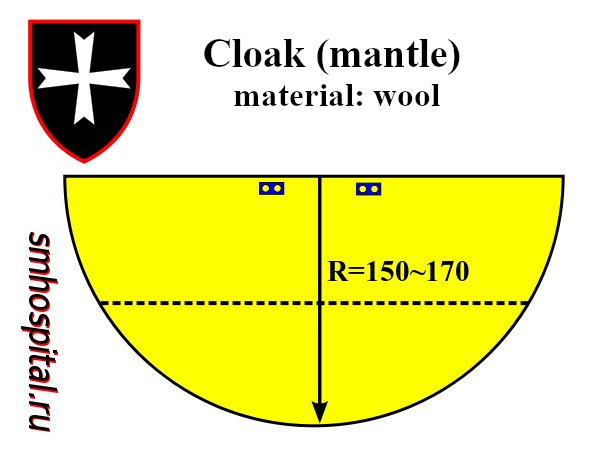
Figure 1 - Cloak pattern.
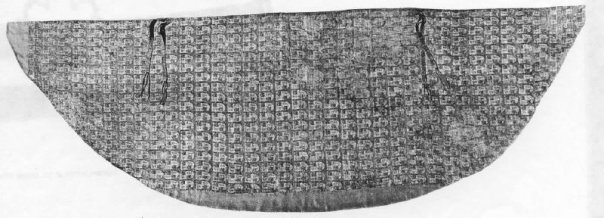
Figure 2 - Cloak of Fernando de la Cerda (1252-1275)
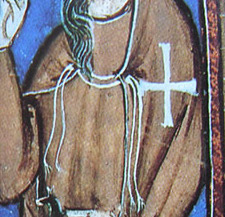
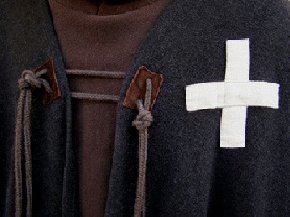
Figure 3 - Cloak clasp: left - the Book of Games, right - reconstruction.
The cloak-mantle was common clothing of the Middle Ages. In monastic orders it was a symbol of belonging to the order:
Rule of Alfonso de Portugal, 1206: ... A brother must have ... and two cloaks (manteaus) - one with fur (a penne, Lat.), and one without.
Nicholas le Lorgne, 1278: It is established that all brothers of the order must wear a black cloak with a white cross (unlike the bull of 1259, where only knights are granted this right).
The cloak is made of wool cloth. The winter version is better lined with fur.
Making:
- First decide on the size: the radius of the cloak can roughly be calculated as your height minus 15 cm.
- Cut the fabric: if the radius is less than 150 cm, it is best to cut from a single piece of fabric 3 m by 1.5 m, then cut it along the dotted line. If the cloak is larger than 1.5 m, cut it from two pieces.
Wondering where to get such a large compass: use a rope of the needed length with a piece of chalk tied to it.
The cloak must be made of two halves: in the Middle Ages the width of fabric was 60-70 cm. There were no looms capable of weaving 1.5 m width. - We sew together the upper and lower halves of the cloak.
- Hem the edge of the cloak.
- Attach two rectangles of leather with holes for the laces. Do not cut the holes in the cloak yet.
- Try it on - if the rectangles are sewn in the right places, you can cut the holes in the cloak.
- Insert the laces - the cloak is ready.
Bibliography
Utulsa (http://www.personal.utulsa.edu/~marc-carlson/cloth/miscclok.html)
© Enton, 2010
Comments (5)