Order мestments, 13th Century
Let us examine the main elements of the Order's мestments, as well as the colors and materials used to make the brethren's clothing.
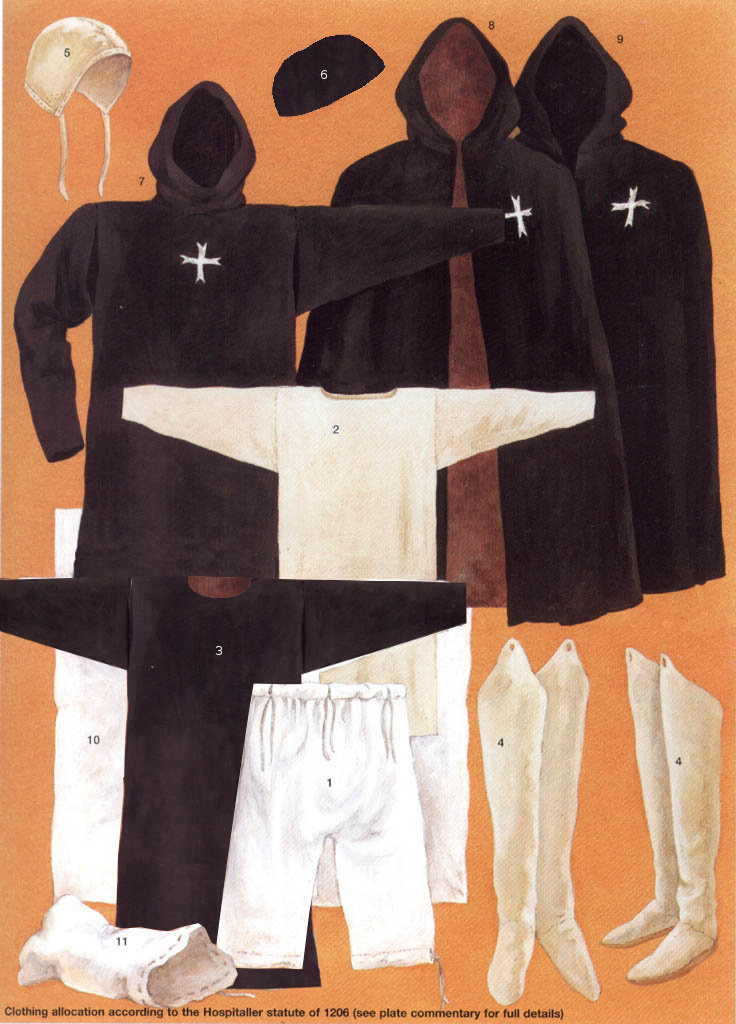
The main elements of the мestments include:
1) Braies (x3)
2) Chemise (x3)
3) Cotte
4) Chausses (one pair linen, one wool)
5) Coif
6) Pillbox hat
7) Black garnache with hood
8) Black wool cloak with fur lining
9) Black wool cloak without fur lining
10) White linen sheet (x4)
11) Bedding bag
The choice of clothing material depended on the
location of the preceptory. In Palestine, for instance,
preference was given to cotton, as it was cheaper in that region. If in Europe, then it was linen.
Here is what the statutes say regarding clothing:
Statute of Alfonso de Portugal, 1206
... A brother must have three chemises and three pairs of braies, one cotte and one pillbox-style cap (chape), three bed sheets plus a fourth in his bag, a cassock and a garnache (garnache et supe), and two cloaks (manteaus)—one fur-lined (a penne) and one without—as well as hose made of linen (lin) and wool.
Statute of Hugh Revel, 1263
It is established that brothers need not remove the fur (la penne) from their garnaches; a brother may either keep the fur on the garnache or possess a garnache without fur.
Here is the data provided by Mr. Nicolle in the journal *Knight Hospitaller*(1):
Hospitaller clothing was largely
derived from monastic attire. The habit—and indeed their clothing in general—was relatively close-fitting.
This was likely due to the need to conserve fabric. It was often not worn during battle so as not to restrict movement,
until 1248, when Pope Innocent IV permitted the brothers
to wear a loose-fitting garment bearing a cross on the chest, though only in 'dangerous situations'.
Crosses were sewn onto the chest of the habit and the left shoulder of the cloak. The cross measured 7–10 cm
and featured the characteristic eight-pointed shape.
Brothers were required to keep them visible when traveling in non-Christian lands.
Colored clothing, velvet, and wild animal furs were strictly prohibited,
in contrast to the lavish civilian attire of the time.
The brothers wore a white coif on their heads, except, of course, during church services.
A regulation from 1280 reiterates that brothers must not
remove their headgear,
even if they are hot, unless there is a compelling reason (such as prayer).
Brothers could also wear a brimmed hat or a white turban.
A 1262 regulation stipulates that on military campaigns, brothers may not wear a turban
of any color other than white. Furthermore, wearing a turban with embroidery or
one that hangs below the waist is prohibited.
Monastic footwear—which was often worn out—was quite simple.
According to the Order's rules, brothers were required to wear only standard footwear.
A regulation from 1270 allowed for the wearing of different footwear, but only when the individual was
in armor.
In 1259, Pope Alexander IV decreed that there should be no distinction between the attire of knights and
sergeants. They were to wear a black mantle (or dark brown, at their discretion). However, in wartime,
they were required to wear a red surcoat (tabard) bearing a white cross.
Reforms introduced in 1295 mention the annual issuance of two sets of clothing.
Comments (29)
All comments