The Shape of the Hospitaller Cross
Unfortunately, there are insufficient sources from the 12th and 13th centuries to
reliably determine the exact size and shape of the Order of St. John's cross.
The earliest depictions of the Hospitaller cross appear on the Order's seals.
When analyzing them, however, one must account for the stylized nature of the imagery
(for instance, to ensure a clearer impression from the seal).
The seals of the early Grand Masters (Raymond du Puy [1120–60] and Cast de Murols [1170–72])
feature the so-called patriarchal cross.
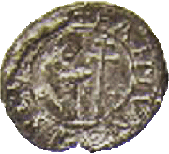
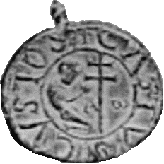

Image: Seal of Raymond du Puy (1120–60),
Cast de Murols (1170–72),
Patriarchal cross
The Latin cross and the so-called Cross Potent also appeared on the Order's seals during the 12th century.
Such depictions can be found, for example, on the seal of Roger de Moulins (1177–87).
Raymond du Puy (1120–60), Cast de Murols (1170–72).
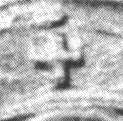
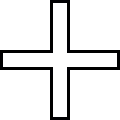
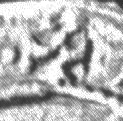

Image – Detail of the seal of Roger de Moulins (1177–87),
Latin (Greek) cross,
Detail of the reverse side of the seal of Roger de Moulins (1177–87),
Cross Potent
The first instance of the Hospitaller cross appearing on clothing is found on the seal of Roger de Moulins (1177–87).
The cross is sewn onto the left shoulder of the Master's mantle and is presumably shaped
like a Cross Formée (a Latin cross with flared arms) or a Cross Potent. It is impossible to
definitively determine the shape of the cross on this seal.
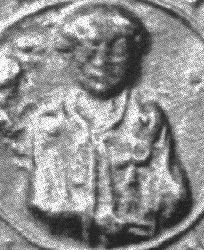

Image – Detail of the seal of Roger de Moulins (1177–87),
Cross Formée
The eight-pointed cross is clearly identifiable for the first time on the seal of the Order's Master, Geoffrey de Donjon (1193–1202).
Its shape (Cross Moline) can be seen more clearly on the seal of the Monastery of St. John in Jerusalem (12th century)
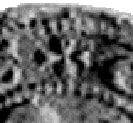

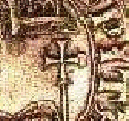

Image - Fragments of the seal of Grand Master Geoffrey de Donjon (1193–1202),
Fragment of the main seal of the Monastery of St. John in Jerusalem (12th century),
Cross Moline
Throughout the 13th century, the Cross Potent, Cross Formée, and Cross Moline appear on Hospitaller seals
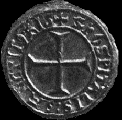
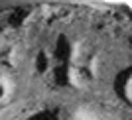
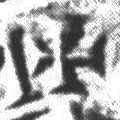
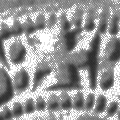
Image – French seal, 1216;
Seal fragments of Garin de Montaigu (1207–28),
Hugues Revel (1258–77),
Nicholas Lorgne (1277–85)
The Grand Masters' mantles depict a *Cross Formée* (Garin de Montaigu) and a *Cross Moline* (Hugues Revel).
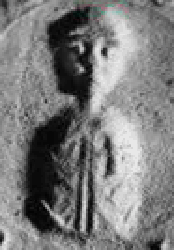
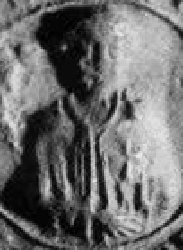
Image – Seal fragments of Garin de Montaigu (1207–28),
Hugues Revel (1258–77)
A miniature from a book of games depicts brethren presumably bearing the *Cross Formée*.
However, Templar brethren in
another miniature are depicted with the *Cross Moline*.
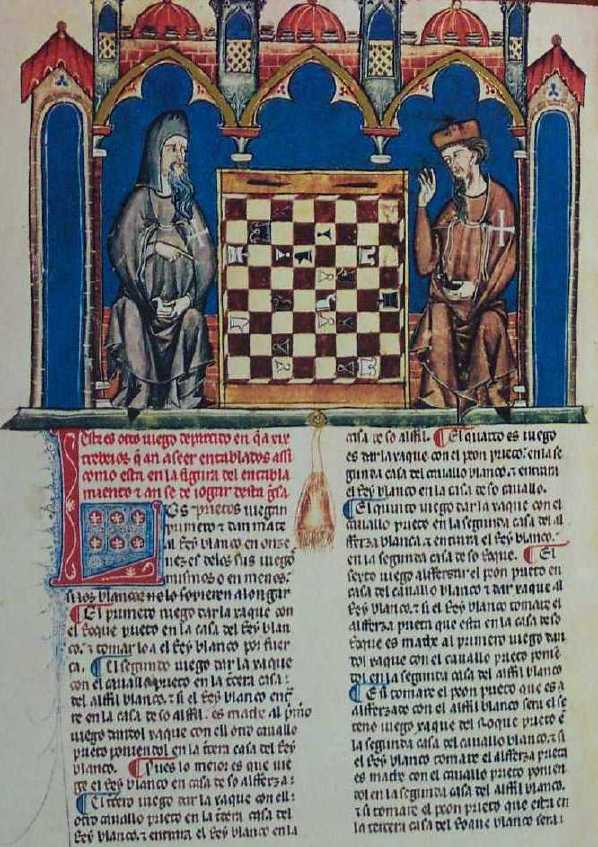
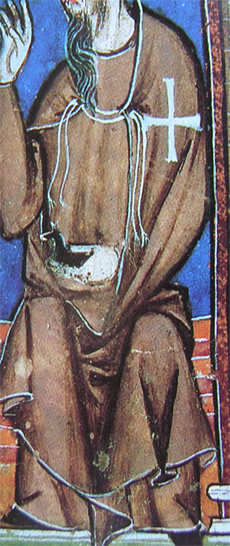
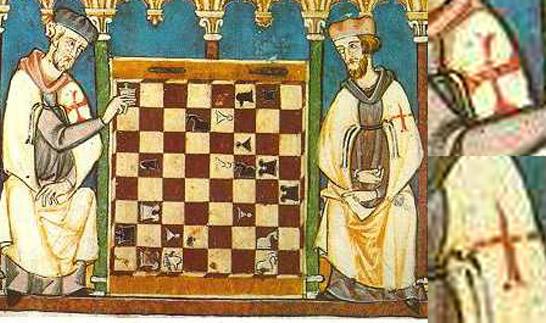
Image – Fragments from the *Book of Games* of Alfonso X (1251–1282): Hospitallers and Templars
The eight-pointed cross (*Cross Moline*) is also depicted on a fresco from 1300. The monks are dressed in a dark brown habit and a black cloak with a cross on the left shoulder.
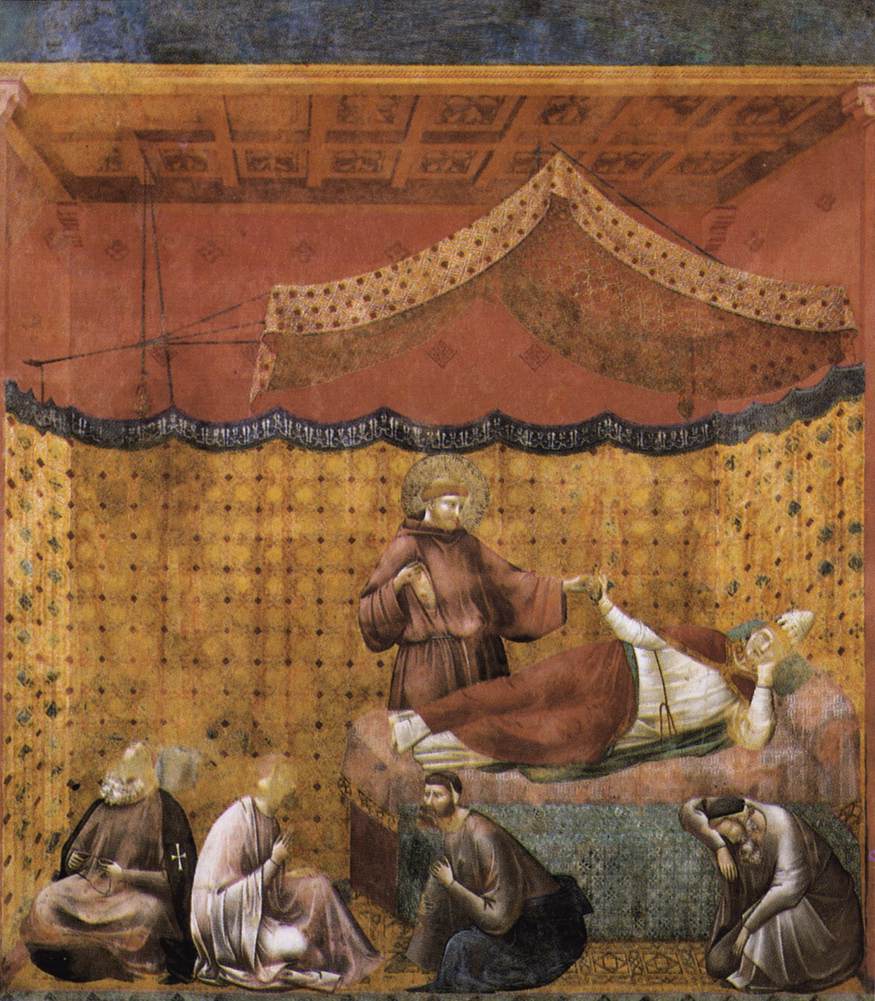
Image – Legend of St. Francis, fresco from 1300 (Legend of St Francis 25 Dream of St Gregory 1300 Fresco, Upper
Church, San Francesco, Assisi) – British Library
The Order's banner in the 13th century bears a simple Latin cross.
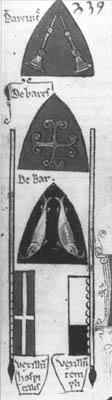
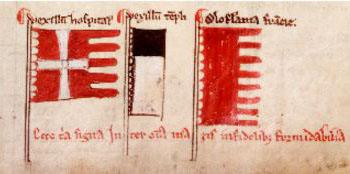
Image – Mid-13th-century miniature (Historia Anglorum, Ms. Roy. 14.CVII, f130v) – British Library,
Chronica Majora by Matthew Paris; 13th-century manuscript (MS 016, folio 142)
An image of a white eight-pointed cross on a red background also appears in the miniature
"The King Leading the Crusaders." There is no evidence that the figure depicted is specifically a Hospitaller knight,
but I believe the shape of the cross may have been similar to that of Hospitaller crosses of the time.
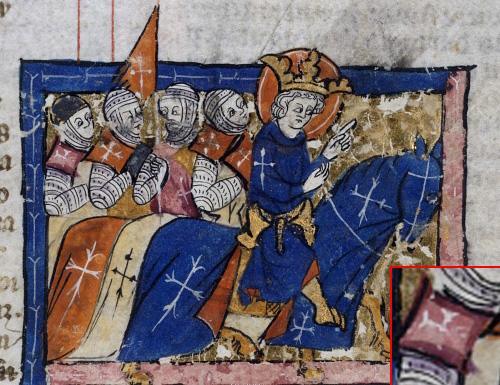
Image – The King Leading the Crusaders, early 14th century, France (Image taken from Abreviamen de las Estorias.
Shelfmark/Page: Egerton 1500, f.57) – British Library
The following miniatures show the cross being worn on the left shoulder.
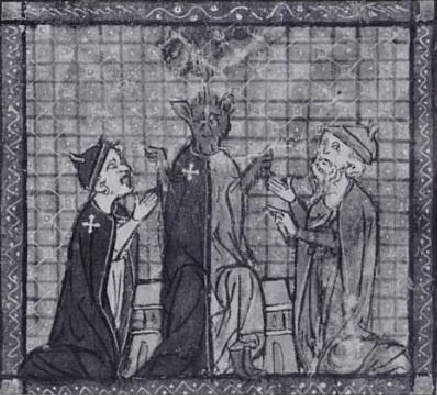
Image – Reynard the Fox during a dispute between a Hospitaller (left) and a Templar (right). Renart de Nouvel, Bibliothèque Nationale, Ms.Fr.372, f.59, Paris, France

Image – Illuminated initial from the *Grant Crónica de España* by Juan Fernández de Heredia, second half of the 14th century – MAA
A miniature from 1355 depicts two Hospitallers, one of whom wears the cross on his chest (rather than on his cloak). Furthermore, the cross is gradually changing its shape to the *formée branchée* style.
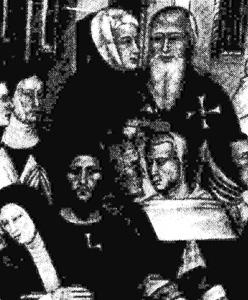

Illustration – Two Hospitaller brothers, Andrea da Firenze, 1355 – MAA,
Cross Formée Branchée
However, a late 14th-century miniature depicting the arrest of the Templars shows the Hospitaller *Cross Moline*. (The artist was likely unfamiliar with the Templars—the Order was dissolved in 1308—and thus depicted them with the crosses he knew: those of the Hospitaller Order.)
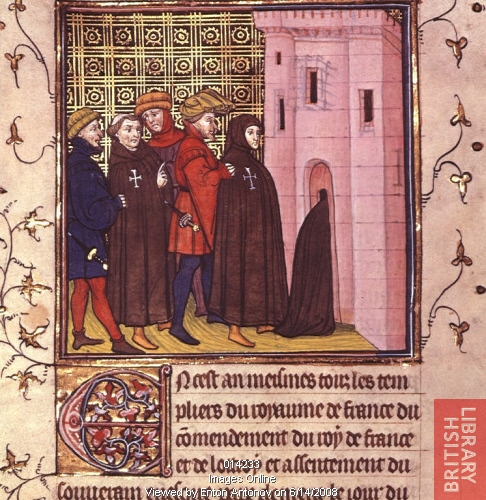
Illustration – Miniature depicting the arrest of the Templars, late 14th century (*Chroniques de France ou de St. Denis*, Shelfmark/Page: Royal 20 C. VII, f.42v) – British Library
By the mid-14th century, the Order's combat attire might also feature a simple Latin cross.
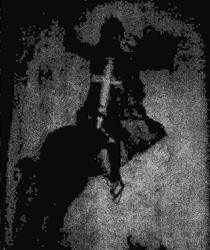
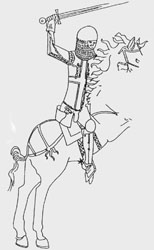
Illustration – Mid-14th-century wall painting (in situ, Avio Castle, Italy) – MAA
Throughout the 15th century, the *cross formée branchée*—which gradually evolved into the Rhodian cross—was used, as was the *cross moline*, which evolved into the Maltese cross (see below).
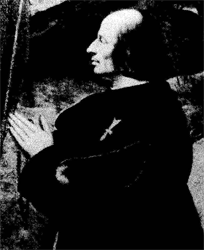

Image: Wall painting by Gaspare da Vimercate (Church of Santa Maria delle Grazie, Milan, Italy), 1450 – MAA;
The second image is unattributed.
The so-called Rhodian cross with straight arms appears in the late 15th-century engravings by Caoursin. Interestingly, this cross also appears on the Order's combat vestments.
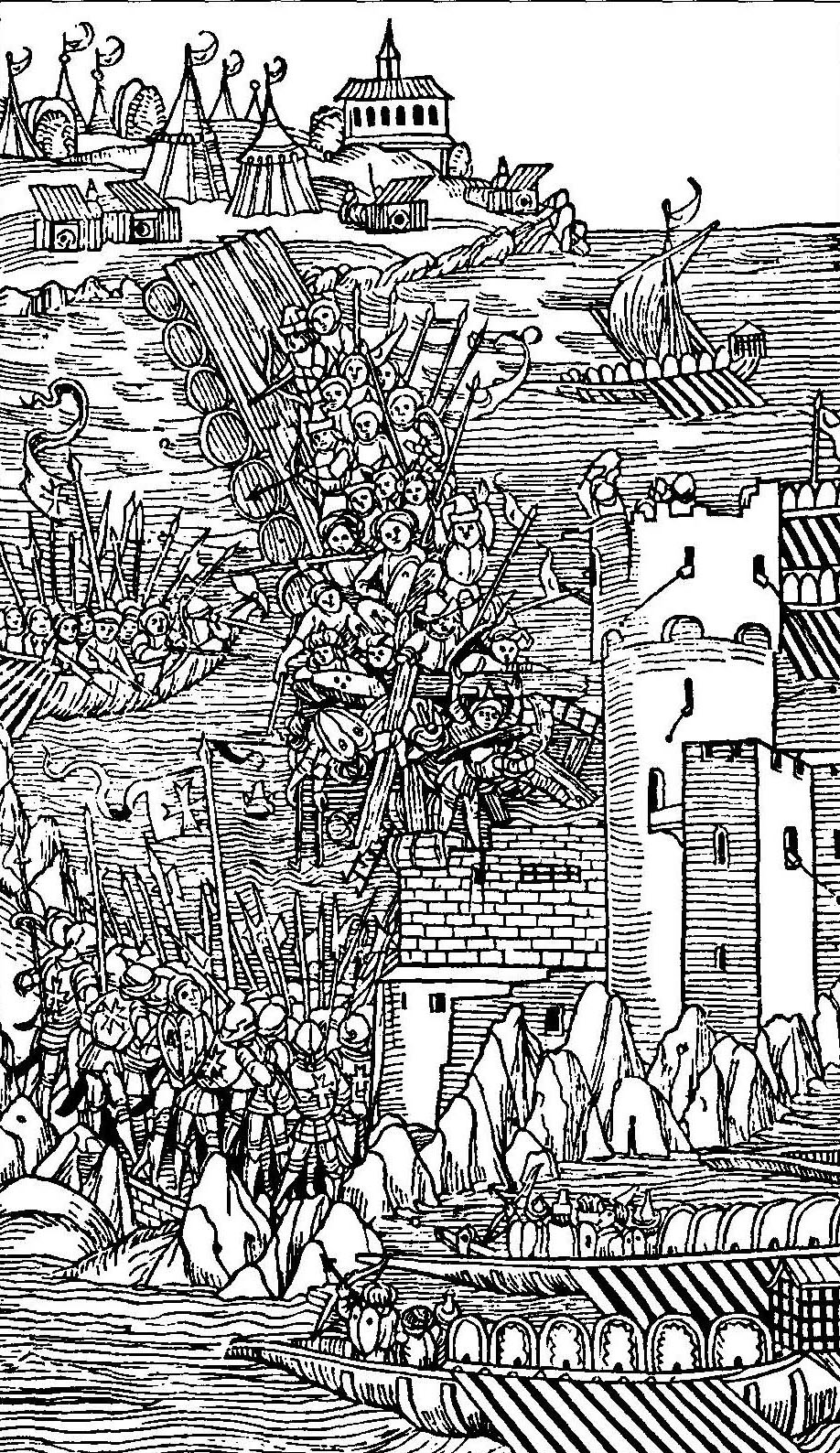
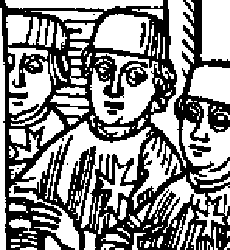
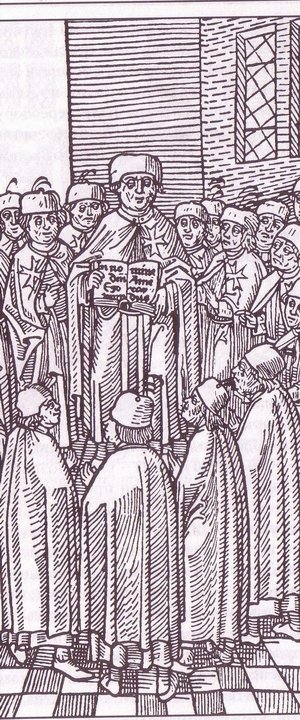

Images 1–3: fragments of carvings associated with Guillaume Caoursin, late 15th century,
Presumed carving associated with Guillaume Caoursin – Chapter in Cyprus, late 15th century,
Rhodian Cross
The Maltese cross first appeared in the late 15th century.

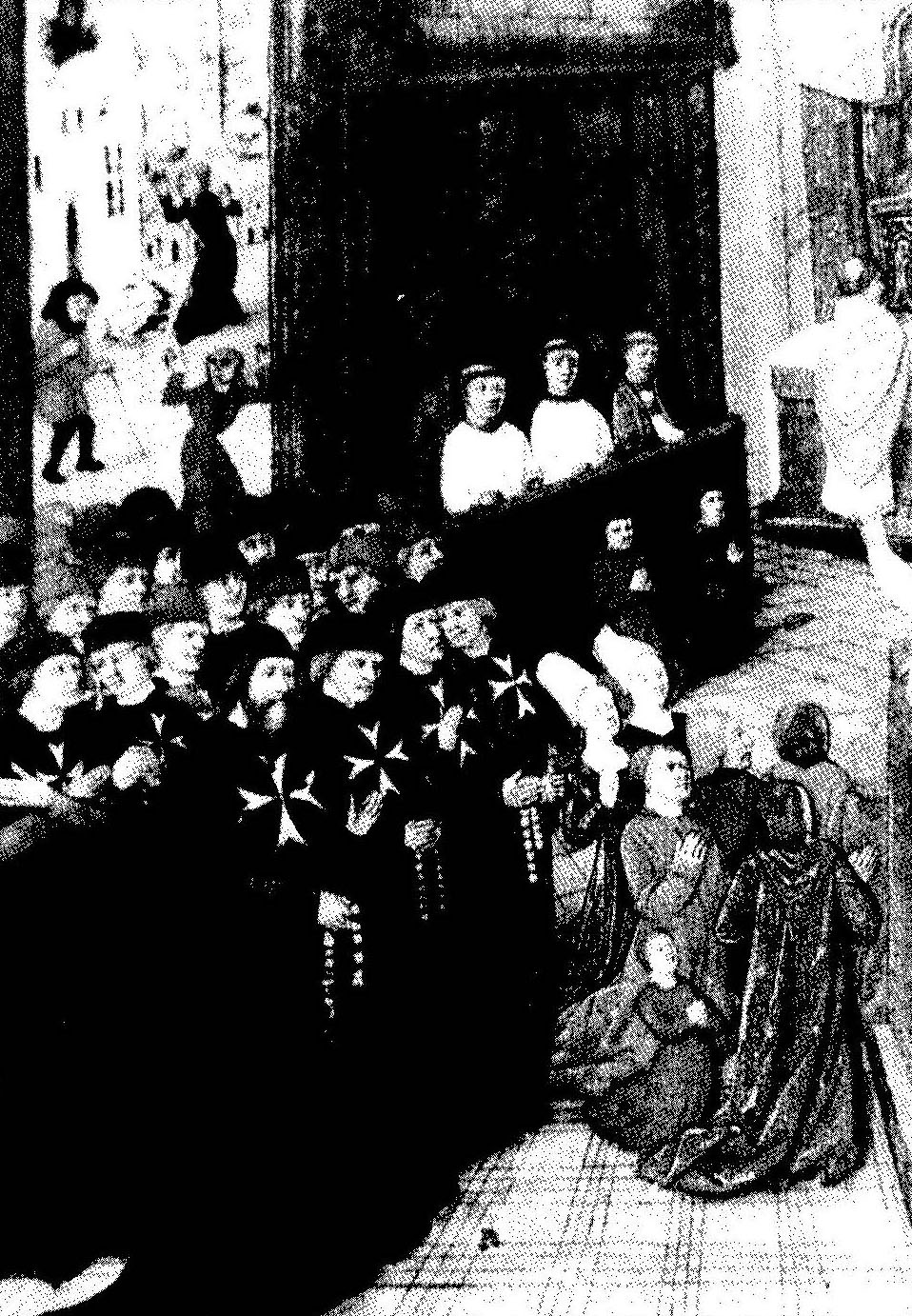

Illustration – Detail from MS Lat, National Library, Paris, 1482–1489,
Knight-brothers and other members of the Order at prayer during the earthquake of 1481, late 15th century – MAA,
Maltese cross
Thus, the shape of the Hospitaller cross evolved gradually from the 12th to the 15th century, with several varieties being worn concurrently. An approximate diagram of this evolution is shown in the following illustration.
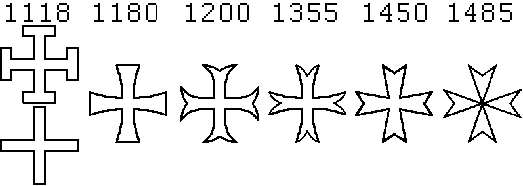
Illustration – Evolution of the Hospitaller cross; the approximate dates of the appearance of each cross shape are indicated
Bibliography
Knight Hospitaller (1) 1100–1306 (Man-at-Arms series – MAA), David Nicolle
Knight Hospitaller (2) 1306–1565 (Man-at-Arms series – MAA), David Nicolle
History of the Maltese Cross, as used by the Order of St John of Jerusalem, The Reverend Dr Michael Foster, 2004
Book of Games of Alfonso X, 1251–1282
British Library
http://www.fflch.usp.br/dh/heros/antigosmodernos/humanismo/heredia/HerediaCorbis.jpg
Collection of seals of the Order of St. John of Jerusalem
© Enton, 2008
Comments (0)
No comments yet. Be the first!